Back in February, Defra gave us a preview of what SFI26 would look like. On 2 June, the actual rules landed.
The good news: the shape Defra trailed held up. The detail that matters when you sit down to plan — payments, eligibility, what can share the same field — is now on the table. And for anyone who has been holding off on building their plan until the rules were confirmed, that wait is over.
Here is what moved between the February preview and the published rules, what it means for your business, and what we are doing about it inside JustFarm.
When Does It Open?
Defra expect to open the first application window ("Window 1") from 30 June 2026. A small number of eligible farmers will be invited to apply from around 18 June so Defra can test the service before full rollout, but for most people 30 June is the date to plan around.
Window 1 is open to two groups — and you only need to be in one of them:
- Small farms — businesses with up to 50 hectares of agricultural land registered with the RPA and linked to your SBI on 1 January 2026.
- Farms without an existing ELM revenue agreement — no live SFI, Countryside Stewardship Mid Tier or Higher Tier, or HLS agreement on 1 January 2026. Standalone Capital Grants, private schemes and Landscape Recovery do not count against you here.
Window 1 will stay open for around two months, but it can close sooner if the budget is fully allocated — and given that SFI24 closed abruptly with no warning in March 2025 when funding ran out, "around two months" should be treated as a ceiling, not a guarantee. Defra will publish updates as the budget reaches 25%, 50% and 75%. It pays to be ready rather than to wait.
Window 2 opens in September 2026 and is open to all farmers and land managers registered with the RPA.
What Changed: the Headline Shape
The structure Defra trailed in February was confirmed:
- 71 actions in the offer — down from 102 under SFI24, so roughly a third of the old actions are gone.
- £100,000 per year cap on an agreement, and one live SFI26 agreement per business (per SBI). You cannot add to an agreement after it starts, and you cannot apply for a second one while the first is live. The plan you submit is your plan for three years.
- Minimum 3 hectares of agricultural land to start an application.
- The standalone SFI management payment is gone for SFI26. In SFI24 this was a fixed £1,000 per year added to every agreement regardless of actions selected — it is not available in SFI26.
If you planned anything off the February preview, those numbers are now firm enough to build on. If you have not planned yet, these are the structural rules to start from.
Payments: a Big Uplift for the Uplands
This one was trailed back in February, but it is now confirmed and worth repeating — and acting on. Several moorland and rough grazing actions pay substantially more under SFI26 than they did under SFI24. Crucially, the higher rates apply to existing SFI agreements as well as new SFI26 ones:
| Action | SFI24 rate | SFI26 rate | Change |
|---|---|---|---|
| UPL1 — moderate livestock grazing on moorland | £20/ha | £35/ha | +75% |
| UPL2 — low livestock grazing on moorland | £53/ha | £89/ha | +68% |
| UPL3 — limited livestock grazing on moorland | £66/ha | £111/ha | +68% |
| UPL8 — shepherding (stock removed ≥4 months) | £43/ha | £74/ha | +72% |
| UPL10 — shepherding (stock removed ≥8 months) | £48/ha | £102/ha | +113% |
If you have moorland or rough grazing and have not revisited your figures since the old scheme, re-running your plan should be your first move. For upland farms, these increases are material — not marginal.
The JustFarm SFI planner has been updated to reflect these confirmed rates, so if you have upland actions in your plan now, you will see the correct published figures.
Payments: Some Rates Have Been Cut
A few actions have come down for new SFI26 agreements. These are deliberate — Defra has said the original rates were set too high and made it too attractive to take productive land out of food production. They are not page errors:
- CSAM3 herbal leys: £382 → £224/ha (down 41%)
- CAHL2 winter bird food on arable and horticultural land: £853 → £648/ha
- CNUM3 legume fallow: £593 → £532/ha
If you hold an existing SFI23 or SFI24 agreement, your current rates are protected — these reductions apply to new SFI26 agreements only.
This is exactly the kind of change that makes planning off published rules important. A plan built on SFI24 herbal ley rates overstates income by 41%. If you built a rough income forecast before 2 June, check it now.
No Paying Twice for the Same Thing
The published rules are explicit: you cannot be paid under SFI26 for work on land that is already paid for under the equivalent Countryside Stewardship option. So winter bird food (CAHL2) can only top up a mix that is not already funded under CS option AB9; herbal leys (CSAM3) reference CS option GS4; and the same logic runs through nutrient management, low-input grassland and several animal health and welfare actions.
In practice, this is easy to get wrong by accident — and painful to unwind after an agreement starts. Checking compatibility between your existing CS agreement and the SFI26 actions you want to add is not straightforward when you are cross-referencing individual action guidance pages on gov.uk.
The JustFarm SFI planner does this check for you. If a parcel is already in the equivalent CS option, the conflicting SFI26 action gets flagged rather than quietly double-counted. You see the problem before you submit, not after.
Clearer Rules on What Can Share the Same Land
The rules now spell out, action by action, what can sit on the same area, how boundary actions (hedgerows, walls, ditches) combine, and how supplements work:
- Supplements must be applied for alongside a base action in the same application — you cannot add one to an agreement later. If you want a supplement, plan it in from the start.
- Boundary and linear actions follow their own compatibility lists.
- The 25% limited-area cap (measured across your whole farm's agricultural area, not per parcel) now includes AHW7 enhanced overwinter stubble.
Getting the compatibility right across 71 actions, Countryside Stewardship, and any existing SFI agreements you hold is genuinely complex. It is the kind of thing that looks manageable when you are looking at one or two actions but compounds quickly as you build a fuller plan.
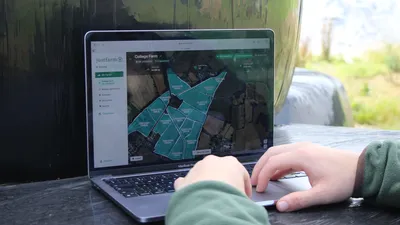
JustFarm's compatibility engine is being updated to match the per-action rules published on 2 June — across SFI26, and across schemes (Countryside Stewardship and earlier SFI years). Instead of cross-referencing Annex A manually, you select your actions and the JustFarm SFI planner tells you what conflicts, what needs a supplement, and what the combined value looks like.
A Simpler, Tighter Scheme
A few other changes confirmed in the published rules that affect how you plan:
- Five-year actions are gone — almost everything now runs for 3 years (a couple of organic conversion actions aside).
- Rotational actions are capped at their year-one area — you can move them around to different parcels and scale down in year two, but you cannot go above the area you entered at the start. Think carefully about this number before you commit. If you plan to be managing 20ha of a rotational action by year three, you need to enter 20ha in year one.
- Tighter eligibility detail on protected land (SSSIs need Natural England consent), where livestock are required, and buffer-strip rules.
The rotational area cap in particular is worth thinking through carefully. There is a real planning tension between entering the area you want to reach eventually and the area you can manage and evidence in year one. It is not a decision to make under time pressure.
One Action Retired, One Added — and it is a Real Change
This is the one genuinely new development since February, and it is more than a rename. The old GRH1 ("manage rough grazing for birds") has been withdrawn and replaced by GRH12 ("manage rough grassland for upland breeding waders"). If you ran GRH1 under SFI24, the differences matter:
It pays considerably more. £203/ha under GRH12, up from £121/ha under GRH1 — a 68% increase.
The target is sharper. GRH1 was about upland birds and wildlife generally. GRH12 is specifically about giving breeding waders — lapwing, snipe, redshank and curlew — the conditions to nest and raise chicks. If you do not have these species on or near your land, it is worth considering whether GRH12 is the right action for your situation.
Grazing is now compulsory, and capped. Under GRH1 you could graze or cut, your choice, with no stocking limit. Under GRH12 you must graze with livestock, and you must keep density to no more than 0.6 grazing livestock units per hectare during the breeding season (roughly mid-March to late July), then graze harder afterwards to get the sward right.
There is new paperwork. GRH12 requires an annual written stocking record for each parcel — livestock numbers, types and ages, month by month. GRH1 had no such requirement. This is evidence you need to be collecting from day one and keeping for seven years from the end of your agreement.
It is tighter during nesting. No cutting and effectively no machinery during the breeding season (bar checking stock around field edges), plus clear rules on keeping the ground wet and on emergency feeding in snow or hard frost.
Different supplements. GRH12 pairs with SPM5 (and, with it, the UPL5/UPL6 moorland supplements) rather than GRH1's GRH11/SPM4/SPM5 set.
In short: more money, but a more prescriptive, wader-focused action. If you held GRH1, it is worth checking whether the new grazing rules fit how you actually manage the land before you roll it forward into SFI26. We are building GRH12 into JustFarm now — the new rate, the stocking rules, and how it combines with everything else.
A Quick Honesty Note
These rules are described by Defra as near-final. Defra intend to publish final versions around mid-June, before applications open. We do not expect big surprises, but if any rate, date or rule moves, we will update the JustFarm SFI planner and tell you. Always check the final guidance before you submit.
What to Do Now
Check your Window 1 eligibility. If your registered agricultural area was 50ha or less on 1 January 2026, or you did not hold a live ELM revenue agreement on that date, you are in Window 1. Start planning now for a 30 June application rather than leaving it until the window opens.
If you have moorland or rough grazing, re-run your plan. The upland increases apply to existing agreements as well as new ones — check whether they change your figures.
If you already hold a Countryside Stewardship agreement, check for overlap before adding SFI26. The double-funding rules are strict. The JustFarm planner now flags these conflicts automatically — use it before you build your application.
If you built a plan before 2 June, open it in JustFarm and check. We are rolling out the published rates, eligibility and compatibility now. Plans built on the February preview or older SFI24 rates may have materially different income figures.
Think through your rotational area before you commit. The year-one area is your ceiling for the whole agreement. This decision deserves proper planning time — not a last-minute figure because the window is open.
Why Use the JustFarm SFI Planner
Planning an SFI26 agreement without a purpose-built tool means working across multiple gov.uk guidance pages, cross-referencing Annex A action by action, checking CS compatibility manually, and building income projections in a spreadsheet that you will have to update every time Defra edits a page.
The JustFarm SFI planner is built specifically for this. Here is what it does that a spreadsheet cannot:
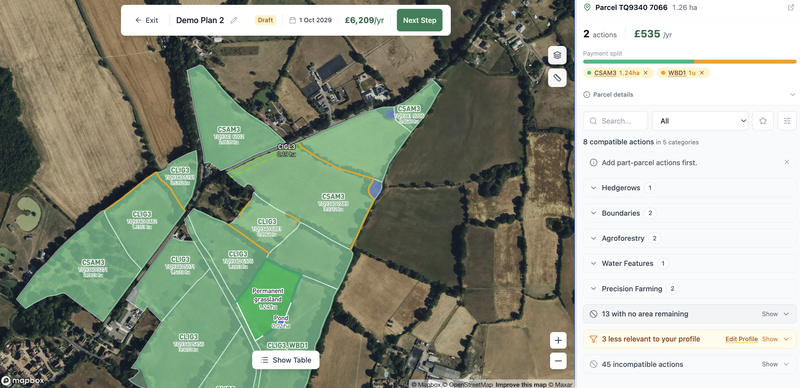
It holds the published rules, not just the rates. Every action in the JustFarm SFI planner is tied to the published edition of the guidance — including eligibility conditions, compatibility rules, supplement requirements, and evidence obligations. When Defra updates a page, we update the JustFarm SFI planner and note what changed.
It checks CS and SFI compatibility automatically. If a parcel is already in a CS option that conflicts with an SFI26 action you are trying to add, the JustFarm SFI planner flags it. No manual cross-referencing, no risk of double-funding that only surfaces at a compliance check.
It calculates your agreement value in real time. Add actions, enter areas, and see your annual agreement value update as you build — including the £100,000 cap check, so you know before you submit whether you are within limit.
It tracks your land parcel by parcel. Rather than thinking about your farm as a whole, the JustFarm SFI planner maps which actions are running on which parcels, which areas are committed, and what rotational capacity you have. This matters particularly for rotational actions where the year-one area becomes your ceiling.
It manages your evidence obligations. SFI26 evidence must be kept for seven years from the end of the agreement. The JustFarm SFI planner organises your evidence by action and parcel, with prompts for what you need and when — so you are building records as you go rather than trying to reconstruct them at inspection.
It handles multiple schemes at once. If you hold an SFI24 agreement and are adding SFI26, or if you have CS Mid Tier alongside SFI, the JustFarm SFI planner shows the full picture across schemes — what is running where, what is compatible, and what your combined income looks like.
Planning SFI26 in a spreadsheet is like navigating with a paper map that goes out of date every time Defra edits a page. The JustFarm SFI planner is the live version — updated to the published rules, checking the interactions you would otherwise have to check manually, and keeping your evidence organised through a three-year agreement.
Start planning your SFI26 agreement in JustFarm →
What JustFarm is Doing About It
We are on it. We have gone through the published rules properly — a line-by-line read of all 71 actions against the official gov.uk pages, not just the summary blog — and we are now working that into the JustFarm SFI planner: the new payment rates, the eligibility and compatibility changes, the Countryside Stewardship double-funding guards, and the GRH1-to-GRH12 swap. We are rolling these updates out over the coming days, and we keep our data tied to exactly which published edition of the rules it matches — so if Defra edits a page we can see what moved and update quickly.
(We read the small print closely enough that we spotted and reported a broken link in Defra's own announcement. They fixed it. That is the level of attention we are putting into your plan.)
SFI26 is official, and JustFarm is updated to match the published rules. We will let you know the moment everything is live — and well before the window opens on 30 June.