Most agreements do not fail at the application stage. They come unstuck later, when someone asks for proof and the records are thin. Under the Sustainable Farming Incentive 2026 (SFI26), the principle is simple and unforgiving: you must supply evidence if you are asked for it, and if you cannot prove you did the work to the standard the action requires, for practical purposes it did not happen.
The finalised SFI26 guidance was published on 17 June 2026, ahead of the first application window opening on 30 June. Now is the right time to understand exactly what you will be expected to keep, because the easiest evidence to produce is the evidence you gathered as you went.
Evidence is set per action, not per farm
There is no single checklist that covers every farm. Each SFI26 action carries its own requirements, and the action guidance tells you what records you have to keep for that specific commitment. The most popular actions each ask for different proof. Herbal leys, winter bird food and legume fallow want establishment and management evidence such as seed mix invoices and dated photos. Hedgerow actions want condition and management records. Soil actions want test results and a soil management plan. The proof for one tells you little about the proof for another.
So the starting point is not a generic folder. It is reading the guidance for each action you intend to take, and noting what it asks you to be able to show. Do that before you apply, while you can still choose actions whose evidence demands fit how you actually work.
The records that come up most often
Across the 71 actions in SFI26, a handful of evidence types appear again and again. If you build these into your routine, you will cover the majority of what most agreements need.
| Evidence type | What it proves | Capture it when |
|---|---|---|
| Dated photographs and short videos | The feature or operation existed and was in the right condition | At establishment and at key points through the year |
| Field operation logs | What was done, when, and who did it | On the day of each operation |
| Invoices and receipts | Seed mixes, contractors, feed or capital items were bought and used | As purchases happen |
| Soil test results and baseline surveys | Starting condition of the land | Before work starts, then as required |
| Maps and field references | The action applies to the correct parcel and boundary | At application and whenever land changes |
| Notes on timing and method | How and when you met the aim of the action | As you carry out each task |
The detail matters more than the volume. A photo with no date and no field reference proves very little. A log entry that says "sprayed off" without a date, a parcel and a name is weaker than one that records all three.
Why timing decides everything
The single biggest difference between an easy evidence trail and a stressful one is when you capture it.
Evidence gathered on the day is accurate. You know the date because it is today. You know the parcel because you are standing in it. You know who did the work because it was you or your contractor that morning. None of that needs reconstructing.
Evidence assembled months later relies on memory, guesswork and rummaging through a glovebox of receipts. It is slow, it is often incomplete, and it tends to be exactly the kind of record that does not hold up if it is questioned. Good evidence is built over time, not produced on demand.
Match the evidence to the parcel
A recurring weakness in evidence trails is proof that cannot be tied to a place. An inspector needs to see that a given action was carried out on the land it was claimed against.
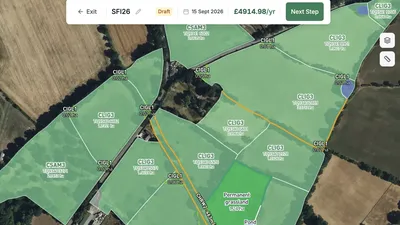
That means every photo, log and test should be linked to a parcel ID or field reference. Your digital maps on the Rural Payments service are the anchor for this. If your boundaries or land covers are wrong, even good evidence can point at the wrong place. Getting the maps right is not just an application task, it is the foundation the whole evidence trail sits on.
A simple system beats a perfect one
You do not need specialist kit to keep good records. A consistent habit beats an elaborate system that no one keeps up.
The minimum that works:
- Photograph operations and features with the date visible, and note which parcel each shot covers.
- Keep a running log of operations with date, parcel, task and who did it.
- File invoices and receipts as they arrive, not at year end.
- Store soil tests, surveys and maps where you can find them quickly.
The aim is that if a request lands, you can answer it from records you already have, rather than starting a search.
What we still do not know
Some action-level detail can be refined over the life of a scheme, and individual action guidance is the authority on what each commitment requires. Where an action's wording is unclear for your situation, check the specific guidance on GOV.UK through the Find funding for land or farms tool rather than assuming a previous scheme's rules still apply.
What to do now
Before you commit to actions, read the guidance for each one and write down what evidence it needs. Confirm your maps are accurate so every record can be tied to the right parcel. Then set up your photo, log, invoice and soil test routine so it starts the day your agreement does, not the day you are asked for proof.
People also ask
What evidence do I need for SFI26? Photos and short videos, field operation logs, invoices and receipts, soil test results, baseline surveys and maps with parcel references. The exact mix depends on the actions you choose, and each action's guidance lists what it requires.
Do I have to send evidence with my SFI26 application? No. You keep the records and supply them if you are asked. The risk is not the application, it is being unable to produce proof later.
What evidence is needed for herbal leys, winter bird food and legume fallow? Typically seed mix invoices, dated establishment and management photos, and field operation logs showing dates and what was done. Check the current action guidance, as payment rates and requirements changed for SFI26.
How long do I need to keep SFI26 records? Keep records for the life of the agreement and afterwards in line with the scheme rules. Storing them in one place from the start makes any later request straightforward.
Where JustFarm fits
Keeping evidence tied to the right action and the right parcel, over a full agreement, is exactly the admin JustFarm is built to carry. It works as an evidence organiser that links photos, field logs, invoices and soil tests to the correct action and date, alongside mapping that keeps your parcels accurate and planning tools that show what each action expects of you before you commit.
It is a practical compliance tool rather than another system to feed, designed to cut the admin and the risk of getting SFI26 evidence wrong. The Basic plan is free, so you can start building your evidence trail today. If you want to see how it handles SFI specifically, the SFI page walks through it. Probably fine is not a compliance strategy, and the time to start is before you are asked.