You have a fortnight, maybe less. The first application window for the Sustainable Farming Incentive 2026 (SFI26) opens on 30 June, and for a lot of farms the work that decides whether an application goes smoothly happens before the window opens at all. Maps need checking. Actions need choosing. Evidence needs starting on day one, not chased six months later when the records are already cold.
This is the part that catches people out. The application itself is not the hard bit. Getting the farm into a state where you can apply with confidence, and then prove what you did, is where the real effort sits.
Who Window 1 is actually for
Window 1 is not open to everyone yet. From 30 June it is open to two groups: farms with up to 50 hectares of agricultural land, and farms without an existing Environmental Land Management (ELM) revenue agreement. The Rural Payments Agency (RPA) has invited a small number of eligible farmers to apply from around 18 June to test the service first.
To be eligible at all, you need at least 3 hectares of agricultural land and your business must have been registered with the RPA by 1 January 2026. The small farm definition is based on land registered with the RPA and linked to your Single Business Identifier (SBI) on that same date.
Everyone else waits for Window 2, which opens to all farms in September 2026.
| Detail | Window 1 | Window 2 |
|---|---|---|
| Opens | 30 June 2026 | September 2026 |
| Who can apply | Farms up to 50ha, and farms with no existing ELM revenue agreement | All eligible farms |
| Budget | Up to £60 million | Part of the wider £240 million for new agreements |
| Duration | Around 2 months, may close early if the budget is allocated | To be confirmed |
That early-close warning matters. Window 1 has a fixed pot of up to £60 million. If demand is high, it can shut before two months are up. Treating 30 June as a soft deadline is a risk if you are eligible now.
Check your maps before you do anything else
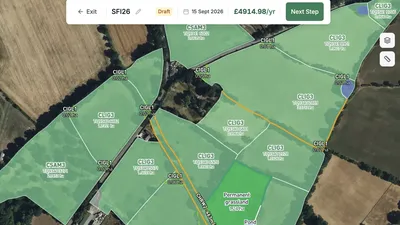
The most common reason an application stalls is the digital map. Before you apply, your maps on the Rural Payments service need to show the land you actually farm, accurately.
Work through this list now, not on the day:
- At least 3 hectares of agricultural land is shown.
- Every land parcel you want in the application is present.
- The total area in hectares for each parcel is correct.
- The land cover for each parcel is right, whether that is arable, permanent grassland, permanent crops or relevant non-agricultural cover.
If a boundary is wrong or a parcel is missing, that is a job for the RPA before you apply, and it can take time. Sorting it in the last week of June is leaving it late.
The 71 actions, and why your old plan may not transfer
SFI26 has been streamlined from 102 actions down to 71. The aim was to keep the options that deliver the best value for food production and the environment, and drop the rest.
If you held an earlier SFI agreement, do not assume your previous choices carry across unchanged. Payment rates have moved. Some moorland grazing and shepherding rates have gone up to reflect livestock prices. At the same time, rates have fallen for herbal leys, winter bird food and legume fallow, which were the three most popular actions under previous schemes. If those were the backbone of your old plan, the numbers behind your new plan will look different.
There are two more rules that change how you plan rather than what you can do. Each farm business can hold one SFI26 agreement, and that agreement cannot be worth more than £100,000 a year. For most farms in the 3 to 500 hectare range that cap is not the binding constraint, but the single-agreement rule means you want your action selection right the first time. The SFI management payment has also ended for new agreements, with that money redirected into the actions themselves.
You can check every action and its mandatory requirements through the Find funding for land or farms tool on GOV.UK.
Evidence starts the day your agreement does
Here is the part that quietly decides whether an agreement goes well. SFI26 works on the basis that you must supply evidence if you are asked for it, and each action's guidance tells you which records you have to keep. If you cannot prove you did the work to the standard the action requires, for practical purposes it did not happen.
The records that come up most often across actions are consistent and worth building into your routine from the start:
| Evidence type | What it proves | Capture it when |
|---|---|---|
| Dated photos and short videos | The feature or operation existed and was in the right condition | At establishment and at key points through the year |
| Field operation logs | What was done, when, and by whom | On the day of each operation |
| Invoices and receipts | Seed mixes, contractors, feed or capital items were bought and used | As purchases happen |
| Soil tests, maps and baseline surveys | Starting condition and that the action applies to the right land | Before and during the agreement |
The trap is timing. Evidence gathered as you go is accurate and quick. Evidence reconstructed months later is slow, stressful and often thinner than an inspector would want. Good evidence is built over time, not assembled in a panic.
What we still do not know
A few things are still moving. The exact close date for Window 1 depends on demand, so it could be earlier than the roughly two-month run. Capital grants are a separate track, with around £225 million expected to be available from July 2026, and the detail there sits alongside SFI26 rather than inside it. If your plan leans on capital items, treat that as its own piece of work.
What to do now
In the next two weeks, in order: confirm whether you are eligible for Window 1, check and correct your digital maps on the Rural Payments service, shortlist your actions from the 71 available and check the current payment rates against your rotation, and set up a simple system to capture photos, logs, invoices and soil tests from the moment your agreement starts.
None of this is complicated on its own. The difficulty is that it is several jobs at once, spread across the whole farm, against a window that can close early. SFI rewards farms that are prepared, and preparation is mostly admin done early rather than late.
Where JustFarm fits
This is the exact problem JustFarm is built around. It brings the moving parts into one place: mapping to get your parcels and areas right, action planning to choose and cost your options before you commit, and an evidence organiser that keeps photos, logs, invoices and soil tests tied to the right action and date. It is a practical compliance and planning tool, not another thing to manage, and it is designed to reduce the admin and the risk that come with getting SFI26 wrong.
If you want to see how it handles SFI specifically, the SFI page walks through it. The Basic plan is free to start, so you can get your maps and evidence in order before Window 1 opens. Probably fine is not a compliance strategy, and the prepared farms are the ones that will move first on 30 June.