The detail in the SFI26 launch that has farmers most uneasy is not the cut in actions, the £100,000 cap, or the loss of the £20 per hectare management payment. It is two short sentences from DEFRA. 'Window 1 will remain open for around two months. It may close sooner if demand is high and the Window 1 budget is fully allocated'.
Translation. SFI26 is first come, first served. Once the money for Window 1 is committed, the link goes away, and eligible farms that were waiting for "a quieter weekend to look at it" will be on the wrong side of the door. Farmers Weekly and FarmingUK have both run pieces this month flagging the same concern. With no published end date, the safe assumption is that the window closes when the money runs out.
This is not a problem you solve by clicking faster on day one. It is a problem you solve by being so prepared that the application takes 30 minutes rather than three days. Here is how to be in that group, and where the planning falls apart for farms that leave it late.
Why "ready to apply" is a higher bar than it sounds
A defensible SFI26 application has four parts that all have to agree with each other.
The land has to be correctly registered with the Rural Payments Agency, with the right land covers shown on your digital maps.
The actions you want have to be selected against the right parcels, within the area caps that apply to certain action groups.
The numbers have to land below the £100,000 annual cap, across one agreement for the whole business, for three years.
The evidence plan for each action has to be realistic. SFI26 carries on the principle that every pound is tied to delivery. Photos, operation logs, invoices, dates, geo-tagged where it matters.
Any one of those four out of step blocks the application or builds a problem into year two. The whole job is keeping them in step from now until submission.
This is exactly the work JustFarm was built for. Mapping that mirrors your RPA parcels. A planner that models action mixes against the £100,000 cap and the action caps before you commit. An evidence organiser that captures what each action needs from day one. The point is not the software. The point is the time it removes from the four jobs above.
Step one: confirm Window 1 eligibility, today
Window 1 is restricted. Two non-negotiables.
Your business must have been registered with the RPA by 1 January 2026, with an SBI that already had agricultural land linked to it on that date. You also need at least 3 hectares of agricultural land linked to that SBI at the point of application.
Then you need to fit one of two categories. A small farm with less than 50 hectares of agricultural land on 1 January 2026. Or a farm without an existing RPA-administered ELM revenue agreement.
If you are not in either category, you wait for Window 2 in September.
A practical check today. Sign into Rural Payments, confirm the total hectarage linked to your SBI on 1 January 2026, and confirm whether you hold an active ELM revenue agreement. If you are on the borderline of 50 hectares, write down the exact figure. It is the one DEFRA will use.
JustFarm pulls this same data from your RPA account into one view, so the Window 1 eligibility test is visible at a glance rather than buried in a tab. If the hectarage is wrong on the RPA side, the same view shows you where to correct it.
Step two: build a realistic action mix against your fields
SFI26 has 71 paid actions. Many of them sound similar. The mix that works on your farm depends on land cover, rotation, livestock, existing CS agreements, and the action caps.
The cap that bites hardest for arable and mixed farms is the 25% rule. Ten actions, taken together, cannot account for more than 25% of your overall agricultural area. The list includes some of the most popular options. AHW7 enhanced winter stubble, the CAHL and CIGL groups for grass strips and field corners, WBD3 winter bird food on arable land, and others. Plan a mix that quietly drifts past 25% across these actions and the application will not validate.
The other constraint that catches farms out is the headline cap. One SFI26 agreement per farm business. £100,000 per agreement year. Three years. The action mix has to make sense across all three years, not just year one.
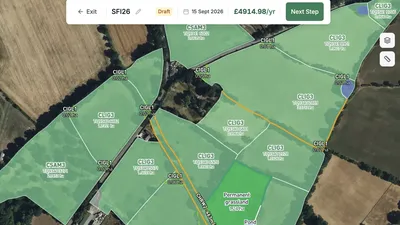
The practical way to build this is to map your fields, lay each candidate action onto the right parcels, and let the totals add up automatically. The mapping tool inside JustFarm does this with the SFI26 rates and caps already in place, so you can see in real time when an action mix exceeds the 25% group cap or pushes a year over £100,000. It is the same work you would do on paper, only without the chance of a transposed digit costing you the application.
The table below sets out the parameters most farms will run into first.
| Constraint | SFI26 rule |
|---|---|
| Agreements per business | One SFI26 agreement |
| Maximum agreement value | £100,000 per agreement year |
| Agreement length | Three years |
| Minimum agricultural land | 3 hectares linked to SBI |
| 25% area cap | Applies to a defined group of actions including AHW7, CAHL1 to 3, CIGL1 to 2, WBD3 |
| Management payment | Removed |
Step three: check the maps and permissions in Rural Payments
DEFRA's "Get ready to apply for SFI26" guidance, published 6 May 2026, is unusually direct. Check your digital maps. Check your contact details. Check your permissions. The reason is that all three quietly block applications in their final form.
Three quick checks.
Every parcel you plan to include is on the map with the correct area in hectares.
The land cover on each parcel is right. Arable, permanent grassland, permanent crops, or relevant non-agricultural cover. The wrong land cover silently excludes a parcel from the action you wanted.
The permissions in Rural Payments allow the right person to submit. If a land agent is applying for you, they need Submit-level permission against your business before the window opens.
JustFarm flags map mismatches against your action plan before submission. If a parcel is logged in the RPA as permanent grassland but you have it pencilled for an arable action, the warning surfaces in the planner, not in a rejection email on day three.
Step four: design the evidence plan before you commit
The principle on evidence in SFI26 has not changed. If you cannot prove it, it did not happen. Every action carries documentation requirements over three years. Photos, dated and located, with operation logs, invoices, and in some cases geo-tagged data.
The mistake is treating evidence as a year-three problem. Year-one evidence starts the day the agreement is accepted. Building a habit of dating and filing field records before June makes the first compliance check a non-event.
JustFarm's evidence organiser is designed around this. Each action carries the documentation requirements it needs. Photos and notes attach against the action and the parcel with date and location preserved. The audit trail builds itself as the work happens, rather than being reconstructed in a hurry when a check letter arrives.
Step five: be ready to submit, not racing
When Window 1 opens in June, the farms that submit cleanly will be the ones whose plans, maps, permissions and evidence schedule were already in agreement.
That last 30 minute job, the submission itself, is the easy part. The hard part is the four weeks of work that go in front of it. The Planner add-on in JustFarm carries the action mix, the cap calculations and the compliance flags into a final pre-submission view, so the application is a confirmation rather than a fresh build.
What we still do not know
DEFRA is still finalising some action-level guidance through May. The exact uptake rate in Window 1 is unknown, so the closing date for the window cannot be predicted. The 2026 Capital Grants applicant guide, due in May, may also affect plans that combine SFI26 actions with capital works.
The safe assumption is that Window 1 will close before its theoretical end. Probably fine is not a compliance strategy, and waiting to see how it goes is not a planning strategy either.
What to do this week
Confirm your Window 1 eligibility on the RPA figures from 1 January 2026.
Tidy your maps. Land covers, parcel areas, contact details, permissions.
Draft an action mix against your fields, on paper or in JustFarm, and check the totals against the £100,000 cap and the 25% area cap.
Start the evidence habit. Photos with date and location for every field operation that might be linked to an action.
Decide which day in June the application will be submitted, and work backwards.
SFI rewards prepared farms. If you want to make the planning, mapping and evidence work part of how the farm runs rather than a sprint in June, create a free account or view pricing to see which plan fits. The Basic plan is free. Pro adds the deeper compliance and evidence features. Planner is a separate add-on for full SFI26 scenario modelling.
FAQS
When does SFI26 Window 1 close? There is no fixed closing date. DEFRA expects Window 1 to run for around two months but has confirmed it may close sooner if the Window 1 budget is fully allocated.
Who can apply in Window 1? Small farms under 50 hectares, or any farm without an existing RPA-administered ELM revenue agreement. You also need at least 3 hectares of agricultural land linked to an SBI registered by 1 January 2026.
What is the 25% area cap? A group of SFI26 actions, including AHW7, CAHL1 to 3, CIGL1 to 2 and WBD3, are limited so that in total they cannot account for more than 25% of a farm's overall agricultural area.
How long do SFI26 agreements last? Three years, with a maximum value of £100,000 per agreement year, and one agreement per farm business.