Picture a Landscape Recovery project five years into delivery. The original project ecologist has moved on. Two of the fifteen landowners involved have sold up, and their successors weren't at the table when the baseline was agreed. The Scheme Lead Entity still has to show Defra, and the private investors funding half the project, that outcomes are on track.
Nobody did anything wrong. This is just what happens over two decades. But if the evidence trail has gaps, it doesn't matter how good the habitat work actually was. Defra's assurance process, and any carbon or biodiversity market the project is selling into, will ask for proof, not a good explanation.
What a Landscape Recovery agreement actually commits you to
Landscape Recovery is the third tier of Environmental Land Management, sitting above the Sustainable Farming Incentive and Countryside Stewardship. It funds large-scale, long-term land use change rather than annual management actions.
Round 1, launched in 2022, took 22 projects into development. Round 2 approved 34 projects, involving more than 700 farmers and landowners across over 200,000 hectares. Defra expects further rounds to call for bids during 2026, alongside another bundle of projects moving from development into delivery.
The legal structure matters here. Defra, or the relevant Managing Authority such as Natural England, signs a single Implementation Agreement with one legal entity, the Scheme Lead Entity. That agreement sets out funded activities, outcomes and milestones, and gives Defra remedies, including step-in, suspension and termination, if delivery or compliance falls short. The Scheme Lead Entity carries that risk on behalf of everyone else in the project.
Implementation itself typically runs for at least 20 years. The first projects, representing over £55 million of blended public and private investment, moved into delivery in the summer of 2025. Round 1 projects are currently going through Defra's assurance process against their original deliverables, which is a useful reminder that this scrutiny is already happening, not a distant future concern.
| Feature | Detail |
|---|---|
| Scheme tier | Third tier of ELM, above SFI and Countryside Stewardship |
| Typical scale | Landscape-level, often 500 hectares plus, multiple landowners |
| Agreement length | 20 to 30 years of implementation |
| Contract holder | A single legal entity, the Scheme Lead Entity, not individual landowners |
| Funding model | Blended finance: public money alongside private investment |
| Non-delivery remedies | Defra can step in, suspend, or terminate the agreement |
Why monitoring breaks down at this scale
A single-farm SFI agreement is hard enough to keep evidenced for three years. Landscape Recovery multiplies every part of that problem.
There isn't one farmer keeping one diary. There are dozens of landowners, tenants, contractors and advisers doing physical work across a landscape, all of which has to roll up into one evidence base that the Scheme Lead Entity can stand behind. People change. Contractors move on. Land changes hands. The baseline habitat and natural capital assessment done at the start of the project doesn't get redone. Every outcome for the next 20 years is measured against it, so if that first record is thin, everything built on it is weaker too.
There's also a commercial layer most SFI and Countryside Stewardship agreements don't have. Many Landscape Recovery projects are structured around biodiversity net gain, carbon credits, water quality offsets or natural flood management payments. Buyers in those markets want measurement, reporting and verification that stands up to independent scrutiny. Weak evidence doesn't just risk a Defra inspection, it risks the private income the project was built around.
Monitor, review, validate
Three separate jobs need to happen continuously, not just when a milestone report is due.
Monitoring is the ground-level capture: what was done, where, when, and by whom, tied to a specific parcel and a specific date, across every landowner in the project.
Review is the periodic check that the accumulated evidence actually matches the milestones and outcomes set out in the Implementation Agreement, done early enough to fix gaps before Defra or an investor finds them.
Validation is the standard the evidence has to meet, whether that's Defra's assurance process, a carbon or biodiversity verifier, or a private funder's due diligence. This is the point where "probably fine" stops being good enough. If it can't be shown, in most of these frameworks, it didn't happen.
What we still don't know
Defra hasn't published full detail on when the next Landscape Recovery round will open in 2026, or exactly what the next bundle of projects moving into implementation will look like. It also isn't yet clear whether monitoring and reporting standards across the scheme will be formalised further as more projects reach delivery. Treat anything beyond "further rounds are expected in 2026" as provisional.
What to do now
If you're leading a Landscape Recovery project, or advising landowners inside one, map every parcel and every landowner's obligations now, while the detail is still fresh, rather than reconstructing it later. Agree one evidence format across the whole project at the outset, so a photo or record from one landowner means the same thing as one from another. Treat every milestone as a mini-audit, not a formality, and check your evidence against it before Defra does.
Where JustFarm fits
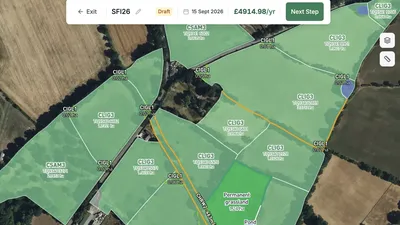
JustFarm already does this at farm level for SFI and Countryside Stewardship: a map-based view of every parcel, every action, and the evidence tied to it, with one dashboard for agents managing work across multiple sites. Landscape Recovery needs the same discipline, just stretched across more landowners and a much longer timeline.
If you're a Scheme Lead Entity, agent or landowner working inside a Landscape Recovery project and want to talk through how to build a monitor, review and validate system that would hold up to Defra's assurance process, get in touch with the JustFarm team. You can also view pricing to see how the platform scales for agents managing multiple clients and sites.
FAQS
What is the Landscape Recovery scheme? It's the third tier of Environmental Land Management, funding large-scale, long-term land use change and habitat restoration projects, usually run by a single legal entity on behalf of multiple landowners.
How long do Landscape Recovery agreements last? Implementation typically runs for at least 20 years, and some projects are structured over 20 to 30 years with blended public and private funding.
Who is legally responsible for a Landscape Recovery project? The Scheme Lead Entity, a single legal entity that signs the Implementation Agreement with Defra or the relevant Managing Authority, and carries the delivery and compliance risk for the whole project.
What happens if a Landscape Recovery project doesn't deliver? Defra has the right to step in, suspend, or terminate the Implementation Agreement where delivery or compliance requirements aren't met.