Matthew's Countryside Stewardship Mid Tier agreement ends in December. His Sustainable Farming Incentive agreement runs out the following May. For most of this year he has had no idea what happens next, or whether there will be a gap in funding while he waits to reapply.
He is not alone. Defra says roughly 13,000 Countryside Stewardship agreements end in December 2026, alongside 4,000 Sustainable Farming Incentive agreements ending between September and December. Every one of those farm businesses is asking the same question: what happens when the old agreement stops and the new one has not started yet.
On 5 August, Defra published an update that answers part of this question, and raises a few more.
What has changed for SFI26 Window 2
The Sustainable Farming Incentive 2026 (SFI26) reopened in June for smaller farms and those without a current Environmental Land Management (ELM) agreement. That is Window 1, and it closes no later than 11:59pm on 28 August. Window 2 opens in September for every farmer and land manager, with a confirmed budget of £180 million plus whatever is left over from Window 1.
Until now, farmers with an ELM agreement (SFI, Countryside Stewardship or Higher Level Stewardship) that was due to end had to wait for it to expire before applying for a new one. Defra does not fund the same land for the same purpose twice, so the old and new agreements could not overlap.
That has now changed, but only for a specific group. Defra's update confirms a new "starting an application early" (SAE) feature inside the SFI26 application service. If your ELM revenue agreement ends on or before 28 February 2027, you will be able to begin an SFI26 application and apply for land that is still in your current agreement, before that agreement ends. This takes effect when Window 2 opens and will be tested with a small number of farmers first.
Who this actually helps
The cutoff matters more than it looks. Farmers whose agreements end on or before 28 February 2027 can use SAE. Farmers whose agreements end on 31 March 2027 or later cannot use it for SFI26 Window 2. Defra says those farmers "may be able to apply for a future SFI offer," with details to follow.
That is a meaningful gap for planning purposes. A three-month difference in your agreement end date currently determines whether you have a bridge into the new scheme or a wait with no confirmed alternative.
| Your ELM agreement ends | What you can do |
|---|---|
| On or before 28 February 2027 | Use SAE to start an SFI26 application for that land before your current agreement ends |
| 31 March 2027 or later | Wait for your agreement to end, then apply through a future SFI offer (timing not yet confirmed) |
| Currently in Window 1 (small farms, no ELM agreement) | Apply now; roughly 1,200 agreements have been offered so far against the £60 million Window 1 budget |
Why the detail matters more than the headline
Defra's rule exists to stop double funding: paying twice for the same action on the same land. That means your evidence trail has to be clean at the point of handover. You need to be able to show exactly which actions were completed and paid under the old agreement, and where the new agreement's actions begin.
If you cannot separate the two clearly, expect the Rural Payments Agency (RPA) to ask questions before it will offer a new agreement. This is where farmers who have kept scrappy, scattered records run into trouble, not because they did anything wrong on the ground, but because they cannot demonstrate it on paper.
Getting your farm ready before September
Advisers are already flagging the same practical issue: RPA maps and land parcel data are often out of date, because farmers used to check them annually as part of the Basic Payment Scheme claim. That routine disappeared with BPS, and errors have crept in since.
Before Window 2 opens, it is worth checking three things.
First, that your land parcels are shown correctly on your digital maps, including land cover and land use. A parcel wrongly recorded as permanent grassland will block an arable-based action, even if the land has been cropped for years.
Second, that any land you want to include is actually shown as available, with no gaps or overlaps against your current agreement.
Third, that your RPA contact details are current, and that any agent applying on your behalf has the right permissions.
None of this is difficult. It is just easy to leave until the window opens and the RPA portal is under heavy load.
What we still don't know
Defra has not yet confirmed the exact date Window 2 opens in September, only that it will follow the close of Window 1. There is no published detail on how applications will be prioritised if demand exceeds the £180 million budget, though Defra has said it will publish allocation updates as it did for Window 1.
It is also unclear whether farmers who wait for their agreement to expire and apply through the ordinary Window 2 route, rather than using SAE, face any restriction on which actions or parcels they can apply for. This has been asked directly on Defra's own blog and has not yet been answered in detail.
Finally, there is no timeline for farmers whose agreements end on 31 March 2027 or later. "A future SFI offer" is not a date, and businesses in this position are currently planning without one.
People also ask
Can I apply for SFI26 if my Countryside Stewardship agreement has not ended yet?
- Only if it ends on or before 28 February 2027, using the SAE feature once Window 2 opens. Agreements ending later currently have no bridging route confirmed.
When does SFI26 Window 2 open?
- Sometime in September 2026. Defra has said it will confirm the exact date once Window 1 closes, which will happen no later than 28 August.
What happens if I miss Window 1?
- You can still apply in Window 2, provided you meet the eligibility rules that apply to that window.
What to do now
Check your ELM agreement end date against the 28 February 2027 cutoff. Log into the RPA portal and correct any land parcel, land cover or land use errors now, not in September. Pull together the evidence for everything completed under your current agreement, so the handover to a new one is clean. And treat "a future SFI offer" as a planning gap, not a guarantee, until Defra says otherwise.
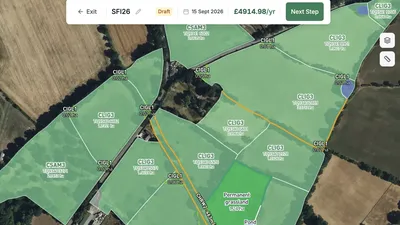
This is exactly the kind of transition that punishes disorganised paperwork and rewards farms that have kept their records straight. A digital map of your farm, agreements and actions in one place makes it far easier to see what has been done, what is still owed, and what evidence you are missing before a scheme boundary catches you out. That's the gap JustFarmis built to close, alongside its compliance dashboard and evidence storage for exactly this kind of moment. If you want to see how it handles your own agreements and maps, you can create a free account or explore the SFI page for more detail. Full plan comparisons, including what is and is not included at each level, are on the pricing page.
Probably fine is not a compliance strategy. When the RPA asks for proof of what happened under your last agreement, "I think it was fine" will not be enough. A record kept as you go along will be.