At first glance, SFI26 appears cleaner and more contained than what came before it.
There are fewer actions.
Several planning actions have been removed.
Five-year commitments are being shortened to three years.
Ministers have spoken about creating a “stable framework for the rest of the Parliament.”
On the surface, that reads as simplification and consolidation.
In practice, it could prove more complicated. And for some farms, it could be financially painful.
That is not alarmism. It is the outcome of modelling.
We are already seeing projected scenarios where businesses that structured their income effectively under SFI23 or Countryside Stewardship could experience reductions of 30 to 40 percent under SFI26, depending on their action mix. That level of reduction is not marginal. It forces operational change.
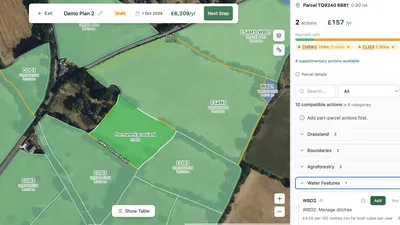
At the same time, the farms that adapt early, model carefully and understand how the cap, windows and compatibility rules interact are likely to benefit most from the new structure. SFI26 rewards preparation more than optimism. Tools such as JustFarm, which allow farms and agents to model agreement values, test stacking combinations and track eligibility in advance, shift the advantage toward those who plan before the window opens rather than during it.
SFI26 is not simply a tidier scheme. It is a redistribution of structure, opportunity and constraint.
What looks simpler
There are genuine structural changes that may reduce friction in certain areas.
Planning actions removed
The removal of some planning actions reduces lines that were often paperwork-heavy and, in practice, not always delivering proportionate value. For some businesses this will reduce administrative complexity, particularly where the income attached to those planning elements was modest relative to the reporting burden.
Fewer planning lines does remove a layer of documentation.
Five-year actions become three-year actions
Shorter commitments reduce lock-in risk.
For:
- Tenant farmers
- Businesses in transition
- Those uncertain about long-term land use
It lowers the perceived risk of committing land to environmental actions in a way that could conflict with future tenancy renegotiations or business restructuring.
Three years is more commercially manageable than five.
A “stable framework”
There has been an explicit commitment to provide stability for the remainder of the Parliament. After several years of iterative scheme redesign, stability itself has value. Farmers and agents can plan around something that is not constantly being reconfigured.
However, stability is only beneficial if the underlying mechanics are workable and financially viable.
What is actually more complex
Behind the simplified surface, structural complexity has increased.
Two application windows
The introduction of two application windows introduces timing as a financial variable.
- Window 1 in June 2026
- Window 2 in September 2026
Eligibility differs between them.
Budget allocation differs between them.
Competition differs between them.
This is not merely administrative sequencing. It could determine access to funding.
Farms that qualify for June potentially operate within a lower-competition environment. Those waiting for September are applying after a portion of the budget has already been allocated.
Timing now shapes financial outcome and opportunity.
The £100,000 cap
The introduction of a hard £100,000 annual cap per business is one of the most significant structural changes in SFI26.
For many smaller farms, the cap will not be a practical constraint based on land area and typical stacking rates. However, it may change behaviour. Some businesses may now treat £100,000 less as a ceiling and more as a target, aiming to stack actions to reach it.
If a large number of eligible farms move quickly and maximise agreement values in Window 1, budget allocation could tighten faster than expected.
That matters because Window 1 has a defined allocation. Strong early uptake could leave less headroom later in the window or reduce flexibility ahead of Window 2.
For larger farms, the cap is a hard financial limit.
At average mid-tier habitat rates, £100,000 equates to roughly 130 to 200 hectares of activity depending on the action mix. Beyond that point, additional eligible land does not increase SFI income.
The same cap therefore operates in two different ways:
- For smaller farms, it may accelerate early uptake.
- For larger farms, it restricts expansion.
Either way, timing and modelling now carry more weight than before.
Rotational action limits
Rotational actions can move fields from year to year, but they cannot exceed the area or value committed in Year 1.
This means the first year of the agreement sets a ceiling that cannot be expanded later.
Undercommitting in Year 1 constrains flexibility for three years. Overcommitting without capacity risks compliance strain.
The strategic weight of Year 1 has increased.
Base and supplemental actions must be applied together
Some actions are now bundled. Base and supplemental elements must be applied for together.
That removes tactical flexibility.
The 25 percent area cap
A 25 percent land area cap applies across certain habitat actions, and AHW7 enhanced overwinter stubble is now included in that grouping.
For arable farms that previously relied heavily on stubbles and related habitat stacking, this alters distribution strategy across the holding.
One agreement per business
Each business may hold only one SFI26 agreement.
No parallel SFI26 agreements.
No splitting land to bypass the cap.
Design becomes holistic.
There is no scope to divide land into separate capped agreements to extend income. The strategy must be consolidated and holistic.
Winners and losers
The redistribution effect is visible.
| Winners | Losers |
|---|---|
| Small farms (≤50ha) | Large farms (>150ha hitting cap) |
| Uplands (payment increases) | Existing agreement holders (waiting for Window 2) |
| New-to-ELM applicants | Planning action income recipients |
| Short-term tenants (3-year actions) | Those reliant on CSAM3, CAHL2, CNUM3 |
The final row is where much of the controversy sits.
CSAM3 herbal leys reduces from £382 per hectare to £224 per hectare. That is a 41 percent reduction.
CAHL2 winter bird food reduces by 24 percent.
CNUM3 legume fallow reduces by 10 percent.
For farms that structured income around these lines, the combined effect could result in reductions approaching 40 percent when restacked under SFI26.
Those businesses will need to redesign their environmental footprint to recover value, often through more complex or higher-risk combinations.
What we still do not know
Several unresolved points make long-term planning difficult.
- Whether SFI26 will retain the same action codes or introduce structural changes to coding.
- Whether underlying management requirements will change beyond published rates.
- Whether inter compatibility rules will remain exactly as they currently operate.
- Whether early exit from existing agreements will be permitted to facilitate transition into SFI26.
Until those points are clarified formally, modelling contains assumptions.
The existing agreement dilemma
Perhaps the most sensitive issue is the position of existing agreement holders.
If you are:
- Over 50 hectares
- Already in SFI or Countryside Stewardship
- And your agreement runs beyond the June window
You cannot apply in Window 1.
You must wait for September.
By September:
- Window 1 budget has already been allocated
- Competition increases
- Funding headroom may be tighter
If your existing agreement extends beyond the application windows, and if early exit is not permitted, you may find yourself waiting for a future opportunity without certainty of timing.
As far as current guidance states, early exit is not confirmed.
That creates a perception problem.
Early adopters of previous environmental schemes may feel indirectly disadvantaged by the structure of the new one.
Defra has not yet provided detailed clarity on how overlapping agreements will be managed long term.
It is a significant policy gap.
The budget risk
Funding allocation remains a central uncertainty.
- Previous SFI openings saw strong demand.
- Window 1 has a dedicated budget, but the exact allocation is not publicly detailed.
- Window 2 could experience pressure if Window 1 demand is high.
- There is no explicit public statement confirming total SFI26 funding across all windows.
Prepared farms can act quickly. Unprepared farms may miss out.
Less prepared businesses may find themselves reacting to allocation pressure.
Timing is no longer neutral, it now influences financial outcome.
The real test
Ultimately, policy structure must be judged by delivery.
We still need to see:
- Whether the application portal is genuinely simpler.
- Whether the evidence burden is reduced in practice.
- Whether payment timing improves.
- Whether RPA processing speeds up.
Until the system is live, simplification is theoretical.
Our verdict
Fewer actions does not automatically mean simpler.
It means fewer options.
New caps, windows and limits introduce new layers of calculation.
At the same time, there are genuine positives.
- A more focused scheme may deliver clearer environmental outcomes.
- Shorter commitments reduce long-term exposure.
- June genuinely offers opportunity for eligible Small farms.
- The scheme is more focused and arguably more coherent.
At the same time:
- Existing agreement holders face legitimate concern.
- Some farms could see meaningful income reductions.
- Existing agreement holders face structural timing challenges.
- Budget clarity is still incomplete.
SFI26 is not a disaster. It is not a windfall. It is a reshaping.
How JustFarm helps cut through the complexity
In a scheme built around eligibility, caps and compatibility, clarity is the advantage.
The Planner allows you to:
Eligibility checker
- Instantly identify which window you qualify for.
Action filter
- See only actions available to your situation.
- Removed and incompatible options hidden automatically.
Cap tracker
- Real-time monitoring against the £100,000 limit.
Plain English guidance
- Clear interpretation of scheme requirements.
Update alerts
- When Defra clarifies outstanding points, you know immediately.
Pro accounts
- Dedicated support navigating complex portfolios.
- Structured evidence capture and compliance tracking.
Create a free account and map your position clearly:
https://justfarm.app
Explore the SFI structure here:
https://justfarm.app/sfi
See Pro features and Planner add-on details here:
https://justfarm.app/pricing
Prepared farms will adapt.
The risk is not change itself.
The risk is navigating it without structure.