If you farm between 3 and 50 hectares, SFI26 is structured to give you first access.
Defra has confirmed that the first SFI26 application window opens in June 2026 and is available to:
- Small farms up to 50 hectares
- Farms without an existing RPA-administered ELM revenue agreement
Importantly, farms between 3 and 50 hectares with an existing ELM agreement are still eligible for Window 1 under the small farm route.
The window is expected to stay open for around two months, but it may close sooner if the allocated budget is fully committed.
June is not just an opening date. It is a capacity-limited window. Prepared farms will submit calmly. Unprepared farms will be building their plan while others are already inside the system.
SFI26 rewards preparation.
What counts as a “small farm”?
For SFI26, the definition is explicit.
- Small farm: up to 50 hectares of agricultural land
- Minimum threshold: at least 3 hectares of agricultural land
This applies to both Window 1 and Window 2.
That means:
- 2.9 hectares does not qualify.
- 3 hectares qualifies.
- 50 hectares qualifies.
- 50.1 hectares does not qualify for Window 1.
Land area is based on agricultural land registered with the RPA.
Commercial implication
If you are close to 50 hectares, confirm your RPA figure now. Small discrepancies could move you into September instead of June.
How JustFarm helps
JustFarm imports your SBI-linked RPA parcels and shows your confirmed agricultural area clearly. You can check your eligibility band before the application window opens.
If you are structuring an SFI26 agreement, our SFI planning overview explains how actions fit together:
https://justfarm.app/sfi
Why small farms get priority access
SFI26 runs with two separate windows.
Window 1, June 2026
Open to:
- Small farms up to 50 hectares
- Farms without an existing RPA-administered ELM revenue agreement
This means:
- A 40 hectare farm with an existing Countryside Stewardship agreement can apply.
- A 45 hectare farm with an existing SFI agreement can apply.
- A 120 hectare farm without any ELM agreement can apply.
- A 120 hectare farm with an existing agreement must wait until September.
Small farm status is its own eligibility route.
Window 2, September 2026
Open to all farms.
Why this matters
June has:
- Fewer eligible applicants
- A defined budget allocation
- Lower immediate competition
September introduces larger holdings and estate-scale applications. Competition increases.
Early closure risk
Defra has stated Window 1 may close early if demand is high and the budget is fully allocated.
Prepared farms reduce stress and risk.
How JustFarm helps
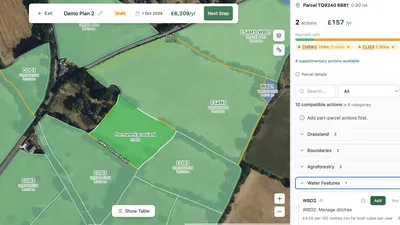
The JustFarm Planner allows you to:
- Build a draft SFI26 agreement before submission
- Test different action combinations
- See projected annual values
- Avoid incompatibility clashes
You refine your agreement before the live system opens.
Planner access is included within Pro accounts:
https://justfarm.app/pricing
What has changed that affects small farms specifically
Several confirmed changes reshape planning.
The £100,000 annual cap
SFI26 introduces a £100,000 per year agreement cap.
For most 3 to 50 hectare farms, this is unlikely to be the limiting factor.
For example:
| Farm size | Average payment per hectare | Estimated annual total |
|---|---|---|
| 20 ha | £300 | £6,000 |
| 35 ha | £400 | £14,000 |
| 50 ha | £500 | £25,000 |
The cap mainly affects larger holdings stacking high-value actions.
For small farms, action suitability and compliance risk matter more than headline totals.
Five-year actions reduced to three years
Actions that were five-year commitments are now three-year commitments.
For tenant farmers, this:
- Reduces lock-in risk
- Improves flexibility
- Lowers long-term exposure
Three years is commercially more manageable than five.
The SFI management payment has been removed
The management payment is no longer part of SFI26.
Administrative workload remains. The standalone admin payment does not.
Efficiency becomes more important.
One agreement per business
Each business can hold only one SFI26 agreement.
Small farms cannot split agreements across separate parcels or structures. Your Year 1 structure sets the ceiling.
Rotational actions capped at Year 1 levels
Rotational actions can move fields annually, but total area and value cannot exceed what is committed in Year 1.
Undercommitting in Year 1 limits you for the full term.
Land caps on certain actions
Some habitat actions are subject to a 25 percent land area cap across the holding.
On a 40 hectare farm, that means a maximum of 10 hectares for those capped actions.
Compatibility and balance matter.
How JustFarm helps
Inside the Planner you can:
- See compatibility automatically
- Model Year 1 ceilings
- Understand capped actions
- Adjust coverage before you commit
You are building a controlled agreement, not guessing inside the application portal.
Which actions make sense at this scale
Small farms benefit from actions that:
- Sit on margins or awkward land
- Align with existing practice
- Are easy to evidence
- Do not compromise core production
Hedgerow management, CHRW2
Pays £13 per 100 metres.
Most small farms have hedgerows already under management. Formalising this through SFI can provide structured income with minimal disruption.
Documentation must match cutting frequency rules.
Buffer strips, CAHL4 and CIGL3
- CAHL4, arable buffer strip, £515 per hectare
- CIGL3, grassland buffer strip, £235 per hectare
These sit naturally along watercourses and field edges.
Accurate measurement is critical.
Pollen and nectar, CAHL1
Best where establishment can be managed consistently.
Avoid fragmented blocks that are hard to monitor.
Cover crops, CSAM2 and SOH3
- CSAM2, winter cover crop, £129 per hectare
- SOH3, summer-sown cover crop, £163 per hectare
Suitable if cover cropping already fits your rotation.
Do not commit beyond your drilling capacity or labour availability.
Precision farming, PRF1
Pays £27 per hectare for variable rate nutrient application.
Only suitable if you genuinely operate variable rate technology and can evidence nutrient planning properly.
How JustFarm helps
JustFarm enables you to:
- Drag and drop actions onto mapped parcels
- Calculate coverage instantly
- Store geotagged photos
- Upload nutrient plans and seed invoices
- Track rotational movements year by year
If you are inspected in Year 2 or Year 3, your evidence is already organised.
What we still do not know
Some operational detail is still to be clarified before June.
Final Window 1 budget size
We know it is capped and may close early. The final allocation figure is not yet published.
Detailed inspection interpretation
Action lists and payment rates are confirmed. Final compliance interpretation may still refine:
- Evidence timing
- Baseline documentation
- Monitoring expectations
Prepared farms will adjust quickly.
What to do before June
If you are between 3 and 50 hectares, act now.
- Confirm your RPA agricultural land area.
- Check your eligibility route, small farm or no existing agreement.
- Map realistic Year 1 rotational areas.
- Identify non-productive land for habitat actions.
- Begin baseline evidence collection immediately.
Good evidence is built over time.
If you cannot prove it, it did not happen.
How JustFarm helps small farms prepare
JustFarm turns preparation into routine.
Planner
- Draft SFI26 agreements before submission
- Check compatibility
- Model projected annual payments
- See proximity to the £100,000 cap
JustFarm Pro Account
Mapping
- Assign actions visually to parcels
- Detect conflicts
- Calculate coverage automatically
Evidence capture
- Geotagged photos
- Field notes
- Seed invoices
- Nutrient plans
- Linked directly to the correct parcel
Compliance dashboard
- Track completeness
- Monitor declaration windows
- Export inspection-ready reports
Create a free account and start structuring your SFI26 plan now:
https://justfarm.app
Explore SFI planning in detail here:
https://justfarm.app/sfi
Review plan options and Planner access here:
https://justfarm.app/pricing
Prepared farms move first
Small farms have priority access in June.
That advantage belongs to those who prepare early.
We will publish further updates as final guidance lands.
Build your evidence now. Not when the window is closing.