Capital Grants pay for real improvements on the farm, from fencing and hedgerows to yards and water infrastructure. However, getting paid for this work is another matter.
Every claim needs the right evidence, labelled the right way, and sent to the RPA on time.
Whether you farm the land yourself or manage claims for clients as an agent, considerable time can go into finding photos, matching them to fields and renaming files.
This guide covers what the RPA needs, where claims get stuck, and how to make them faster.
What are Capital Grants?
Capital Grants are one-off payments from the Rural Payments Agency (RPA) that help farmers and land managers in England pay for environmental improvements. They fund physical work on the farm, and are paid after the work is finished, so you need to cover the costs up front.
What are Capital Grants used for?
Capital Grants pay for work that improves water quality, air quality and biodiversity, manages flood risk, and restores hedgerows, boundaries and orchards. Typical items include:
- planting and restoring hedgerows, and new fencing and gates
- planting trees and orchards
- yard works, roofing and drainage that keep clean and dirty water apart
- natural flood management, such as leaky dams and ponds
Items are split into six groups: boundaries, trees and orchards; water quality; air quality; natural flood management; assessments; and improvements.
Funding caps apply to four groups: up to £35,000 for boundaries, trees and orchards, and up to £25,000 across water quality, air quality and natural flood management.
Who is eligible for Capital Grants?
Capital Grants are open to farmers, land managers and rural businesses whose land is entirely in England. The main rules are:
- Your land must be registered in the Rural Payments service.
- You need management control of the land for 5 years from the agreement start date. If you don't have this, your landlord must countersign the application.
- Tenants can apply if their tenancy gives them that control, or with the landlord's countersignature.
- One application per SBI per calendar year.
- Some items need Catchment Sensitive Farming (CSF) support before they can be approved.
- No work before the start date. Work done or materials bought before the agreement starts won't be paid, and items already funded by other public money aren't eligible.
Rules can change each year, so check the current applicant's guide before you apply.
(Note - the current Capital Grant window closed on 1 September 2026 after all the £225 million budget had been allocated.)
What evidence do you need for a Capital Grant claim?
For most Capital Grant items, you need dated photos that prove the work is done, sent with your payment claim. For some items you also need "before work" photos taken from the same spot, and receipted invoices to show what you paid.
The rules are reasonably straight forward. However, gathering the evidence is where the time goes.
Why Capital Grant claims take so long to prepare
These are the problems we regularly hear from farmers and agents when pulling together a Capital Grant claim:
- Photos are scattered. The photo of the new fence is buried among thousands of others on someone's phone, and more are in a WhatsApp from the contractor.
- It's hard to match photos to fields. Weeks later, you can't always tell which photo belongs to which field or item.
- Every file needs renaming. The RPA asks for photos to be labelled with the field's OS map sheet and grid reference, the item code, the date, the agreement holder's name, the SBI and an image number.
- Details live in different places. Field references sit in a spreadsheet, quantities in the agreement and invoices in an inbox.
For agents handling many claims, this can mean an afternoon per claim spent renaming files and pasting them into a Word document.
How do you claim a Capital Grant?
You can claim once the work is finished and you've been invoiced by your contractor or supplier. The steps are:
- Finish the work within 3 years of your agreement start date.
- Gather your evidence: dated photos of the completed work (plus "before" photos where needed), receipted invoices and any consents.
- Label every photo in the RPA's format.
- Submit your claim online by signing in to the Rural Payments service.
- Send your supporting evidence so it reaches the RPA by the "claim by" date in your agreement.
The minimum claim is £500, although this doesn't apply to the final claim if you're making part claims. The RPA aims to pay valid claims within 2 months, and missing, unclear and not enough photo evidence slows this down.
How JustFarm makes Capital Grant claims faster
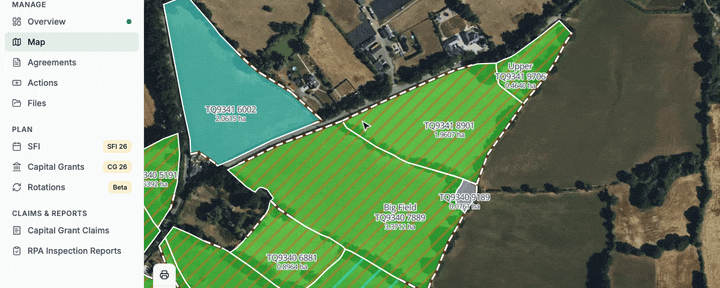
JustFarm already brings your Capital Grant, SFI and Countryside Stewardship agreements into one place, with over 3,000 farms on the platform.
Our new Capital Grant claim packs tackle the evidence problem head on.
Capital Grant claim packs: RPA-ready evidence in minutes
In the JustFarm mobile app, take evidence photos while you're out in the field, saving each one against the right item and field as you go. You can invite a contractor, partner or agent to add their own photos too.
When it's time to claim, pick the items and evidence and download a Capital Grant claim pack. It includes:
- the item schedule, fields, quantities and values
- every photo, renamed automatically to the format the RPA asks for
No more digging through your camera roll and WhatsApp the night before the deadline. One agent told us it saved them at least two hours of claim admin per claim.
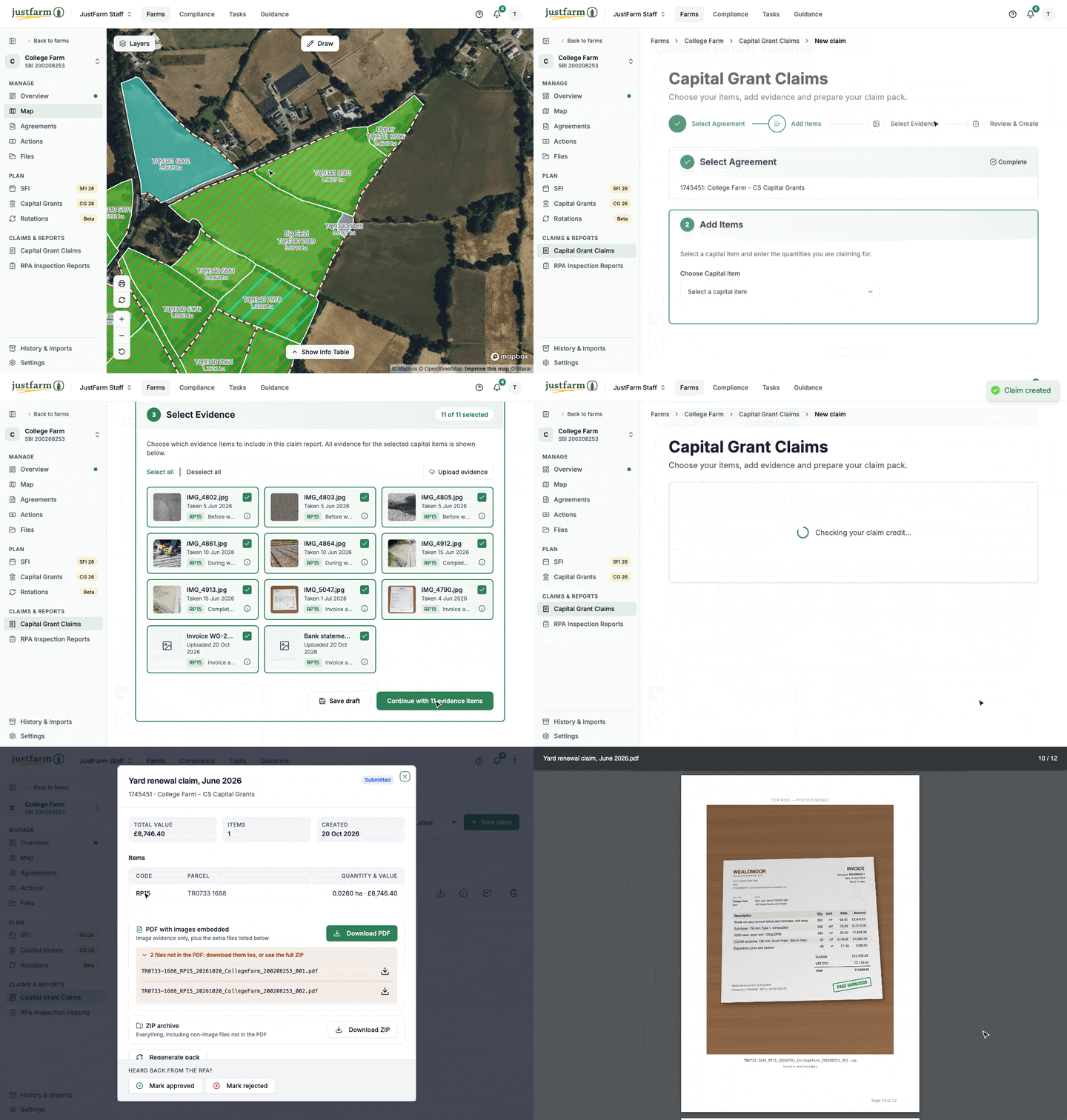
See Capital Grant claim packs in action
Whether you look after one farm or a hundred, JustFarm keeps your Capital Grant evidence in one place, so you spend less time on claim admin and more time on the land.
Book a demo and we'll show you how it works.